

Diamond Beach in Iceland: Your Ultimate Travel Guide
- GoAndXplore
- No Comments
Diamond Beach in Iceland: Your Ultimate Travel Guide
- GoAndXplore
- No Comments
Facebook
Pinterest
LinkedIn
Twitter
Diamond Beach in Iceland is one of those places that stays with you long after you leave. Ola and I have visited this beach more than five times, in both summer and winter, and somehow it never feels boring.
As someone who explores Iceland actively, we believe Diamond Beach is not just a quick photo stop. It’s a place worth slowing down for, observing the ocean, and understanding how glaciers, tides, and weather interact in real time.
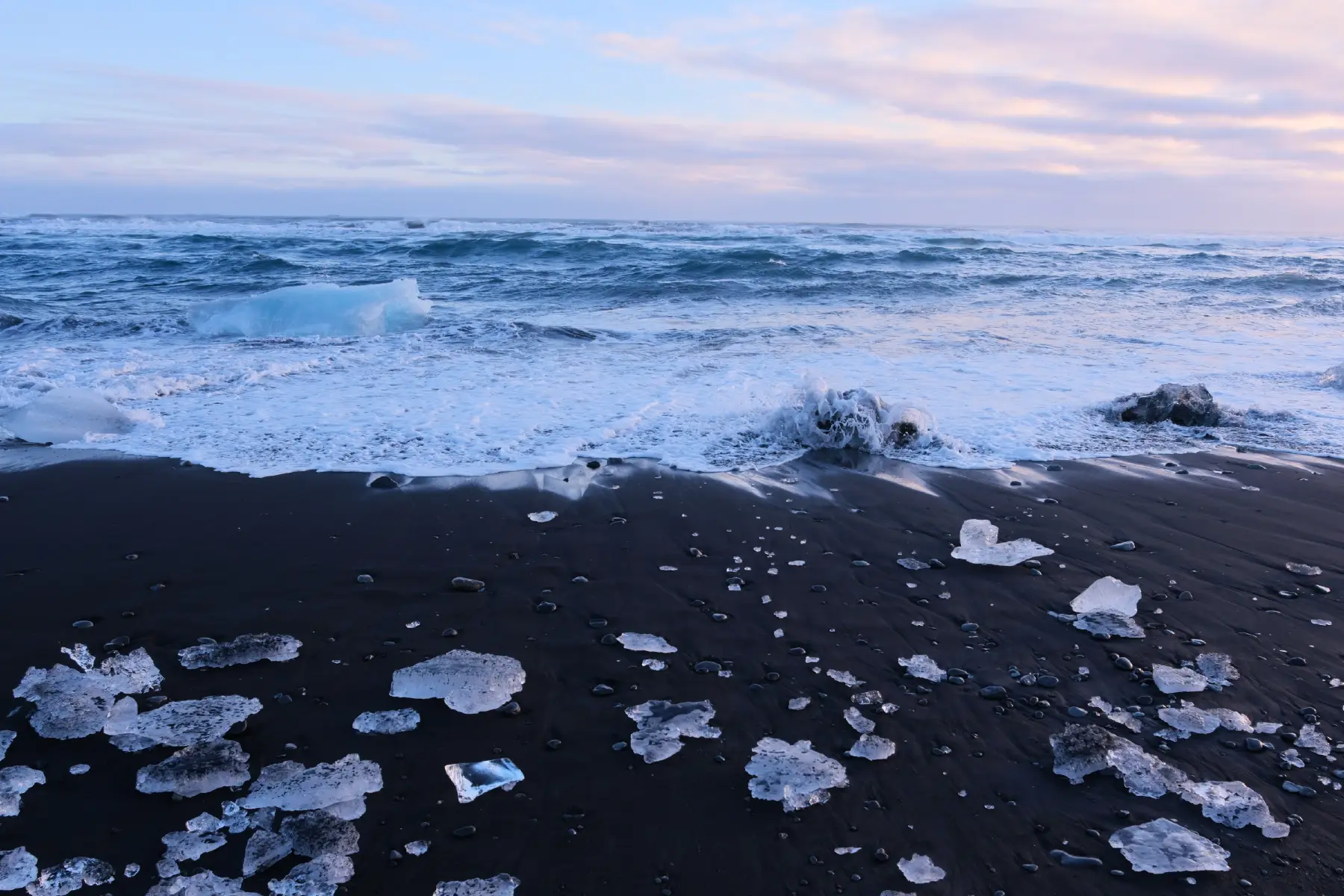
If you’re planning to explore Diamond Beach in Iceland, here’s everything you need to know.
TABLE OF CONTENTS
How to Get to Diamond Beach?
Self‑drive is the most popular and flexible option. The beach is located just off Route 1 (the Ring Road) in Southeast Iceland, right next to Jökulsárlón Glacier Lagoon, and it’s very easy to find with clear signs along the way.
Here’s the location on Google Maps
Diamond Beach Iceland Directions
Here are Diamond Beach directions from major towns and cities.
- From Reykjavík: Drive east on Route 1 for 379 km (236 miles), about a 5–6 hour drive without stops.
- From Vík: Around 190 km (119 miles), ~2.5 hours east along the Ring Road.
- From Höfn: About 80 km, ~1 hour west on Route 1.
The journey itself is part of the experience.
You’ll pass waterfalls, dramatic coastlines, and glacier vistas, so plan to explore en route rather than rushing straight through.

Diamond Beach Iceland Parking
People often ask about Diamond Beach parking, and it’s good to understand this before you arrive.
There are two main parking areas divided by the Jökulsárlón river and the only access is over the bridge.

Both are right off the Ring Road with short walks to the shoreline:
- Eystri‑Fellsfjara (East) — quieter, scenic views
- Vestari‑Fellsfjara (West) — closer to the lagoon side and busier at peak times
To further understand the parking lots, you can have a look at the Diamond beach map here:
Diamond Beach Parking Details
Parking fee is 1040 ISK (~$7–8 USD) and is payable via Parka app. Parking validity typically ends at midnight of the paid day.
East & West lots, and Jökulsárlón parking are considered one payment zone. So, if you visit another paid Vatnajökull National Park site on the same day (such as Skaftafell Visitor Centre), you’ll receive a 50% discount on the second parking fee.
From both parking lots, the beach is clearly visible and requires no GPS navigation once you arrive.
Moreover, you don’t need to move your car to visit Jökulsárlón from the western parking lot.

A clearly visible walking path follows the river, passing under the bridge, and connects Diamond Beach directly to the glacier lagoon.

It’s an easy, scenic walk and a great way to experience both locations without moving your vehicle.
Diamond Beach Guided Tours
If you prefer not to drive, guided options offer multi‑day and day trip packages that include transportation, accommodation, and local knowledge.
Most tours combine Jökulsárlón + Diamond Beach with waterfalls and glacier viewpoints.
We highly recommend choosing operators certified by Vakinn, Iceland’s official quality and environmental certification system, managed by the Icelandic Tourist Board.
Day Tour
Multi-Day Tour
- Summer: Complete Ring Road (1 week)
- Winter: Complete Ring Road (6 days)
Self-Drive
- Summer: Iceland Self-Drive Tour (1 week)
- Winter: Northern Lights Self-Drive Tour (1 week)
These tours are especially useful in winter when weather conditions makes driving more challenging.
Taking a Bus to Diamond Beach, Iceland
There is limited public bus service (Strætó Bus 51) from Reykjavik to Jökulsárlón on weekdays (excluding Wednesdays), making the beach accessible without a car.
For most travelers, public transport is not ideal for this location, as schedules are long and inflexible. Please visit the official Strætó website for up-to-date bus schedules.
Where to Stay Near Diamond Beach?
Diamond Beach in Iceland is quite far from major cities, so most visitors choose to stay overnight in nearby towns. There are no hotels directly on the beach, but you have many excellent options nearby.

Here’s a breakdown of good places to stay. These are within 15–40 minutes from the beach and make great bases for exploring both the beach and Jökulsárlón Glacier Lagoon.
Hotels
- Fosshotel Glacier Lagoon: High‑end, great views, restaurant nearby, 20-minute drive from the beach
- Hali Country Hotel: Mid-range option, cozy, local museum on site
- Fosshotel Vatnajökull: Located just 2km from the Ring Road, near both Jokulsárlón and Skaftafell National Park
- Glacier Lagoon Hotel: also known as Hotel Jokulsarlon, is an ideal base for exploring Southeast Iceland
- Hotel Skaftafell: Ideal if you plan to combine the beach with hiking in Skaftafell
Campsite
- Skaftafell Campsite: One of the best-equipped campsites in Iceland, open year-round, price is 2,800 ISK per adult/night (+ electricity if needed)
Exploring Diamond Beach, Iceland
The bridge that spans the Jökulsárlón river is a key landmark. It divides the two main parking areas and gives you easy access to both sides of the beach.
For exploring the beach, simply follow the coastline. The beach is fully visible from both parking areas, and no trail map is needed.

The landscape is constantly transforming — icebergs drifting from the Jökulsárlón Glacier Lagoon into the Atlantic Ocean break into smaller pieces, and the waves carry ice chunks back onto the black sand.
These ever-changing ice formations create a surreal contrast and attract travelers, photographers, and nature lovers from all over the world.

Even within a single day, the tides, wind, and sunlight can change the entire look of the shoreline. Icebergs that were perfectly positioned for photos in the morning may shift or melt entirely by afternoon.
Wildlife at Diamond Beach
Wildlife encounters add another layer of magic to the experience.
Seals are often spotted lounging on icebergs or swimming near the shore, while Seabirds swoop across the waves hunting for fish.

You can also spot Orcas during winter and early spring, though sightings are rare.
Occasionally, you might even catch a glimpse of Arctic terns or other migratory birds, making the beach a small but thriving ecosystem.
Photography at Diamond Beach
The interplay of light and ice at the beach is particularly spectacular for photographers.
Early morning or late evening light casts long shadows and makes the ice sparkle like gemstones.

Sometimes, light variations can give the illusion of day on one side and night on the other.
Even cloudy days offer dramatic contrasts between the luminous ice, the black volcanic sand, and the often-turbulent waves, creating moody, cinematic landscapes.
Hiking Near Diamond Beach
Nearby hiking options include:
- Svartifoss hike: Moderate trail, 1.5–2 hours round trip. Famous for its basalt column formations and scenic views.
- Kristínartindar hike: Challenging 6–8 hour loop with panoramic vistas of Vatnajökull and its outlet glaciers. Perfect for experienced hikers seeking a full-day adventure.
- Múlagljúfur hike: A 2–3 hour hike, located 22 km (14 mil) from the beach. Ideal for photography and nature enthusiasts.
If you’re looking for more hiking options, Skaftafell National Park (located just 45 minutes away) offers several other trails as well.
When to Visit Diamond Beach in Iceland?
People often ask us when is the best time to explore Diamond Beach. Well, the answer depends on what you want to see. The beach is open year‑round and offers something different each season.
Summer (June–August)
- Long daylight hours (near-midnight sun)
- Light is bright, most days not ideal for photography
- Highest chance of large ice accumulation, typically after stormy weather
- Peak of the season, tend to be very busy
- Easier road access
Shoulder Seasons (May & September)
- Fewer crowds
- Better light for photography
- Weather can change quickly
Winter (October–March)
- Fewer ice chunks on average, but denser and bluer ice
- Icy/snowy black sands creates strong contrast
- Astonishing sunsets and excellent light conditions
- Northern Lights possible during clear nights
- Short daylight and potential road closures
If you’re new to traveling Iceland, we recommend to check our detailed weather guide.
What is the Best Time to Explore?
Over the years, we’ve noticed that the highest accumulation of “diamonds” usually appears after stormy weather.
Heavy rain and strong winds accelerates calving at the glacier front and help break up large icebergs into smaller pieces.
Combined with warmer summer temperatures, these conditions often create the most spectacular displays along the beach.

As temperatures drop later in the year, fewer ice chunks make it to shore, so the best time to experience Diamond Beach is typically during summer and after a storm.
In winter, however, the scene can be truly astonishing: the ice tends to be denser, more compact, and strikingly blue, offering a beautiful contrast against the snowy and icy surroundings and the dark volcanic sands.

The best time to visit in winter is right after sudden temperature drop, that’s the moment ice rapidly expands and breaks, creating perfect conditions for photography.
What to Wear & Pack?

As someone working in the outdoors, we would recommend the following:
- Waterproof jacket and pants
- Warm mid-layers (even in summer)
- Wind-resistant outer shell
- Waterproof hiking shoes or boots
- Hat and gloves
- Sunglasses
- Reusable water bottle
- Camera with lens protection (salt spray is real)
Wind is often the biggest challenge here. For more details on packing, see this detailed packing guide for Iceland.
Interesting Facts
- Despite the name “Diamond Beach”, no actual diamonds are on the beach, the term comes from the sparkling ice appearance.
- The ice comes from Breiðamerkurjökull, an outlet of Vatnajökull (Europe’s largest glacier).
- Ice on the beach changes daily. There’s no guarantee of how much, how big, or how shaped the “diamonds” will be on any given day.
- Jökulsárlón Lagoon and Diamond Beach were formed due to climate change, as Breiðamerkurjökull glacier retreated due to warmer temperatures.
Travel Tips
Never climb on icebergs, they’re unstable and can flip unexpectedly.
Watch the water, waves can be strong and unpredictable (sneakers waves). Face the ocean when close to the shore.
Dress for wind and cold even in summer.
Follow Leave No Trace principles.
Respect wildlife. Observe seals from a distance; do not feed or disturb them.
Walk responsibly. Avoid stepping on protected moss or delicate ground.
Golden hour gives the best light for sparkling ice and photography. Explore both sides of the bridge for varied angles.
Never climb on icebergs, they’re unstable and can flip unexpectedly.
Watch the water, waves can be strong and unpredictable (sneakers waves). Face the ocean when close to the shore.
Dress for wind and cold even in summer.
Follow Leave No Trace principles.
Respect wildlife. Observe seals from a distance; do not feed or disturb them.
Walk responsibly. Avoid stepping on protected moss or delicate ground.
Golden hour gives the best light for sparkling ice and photography. Explore both sides of the bridge for varied angles.
Summary
Diamond Beach in Iceland is a mesmerizing black sand beach where icebergs from Jökulsárlón Glacier Lagoon wash ashore, sparkling like diamonds against the dark volcanic sand. Having visited over five times, in both summer and winter, we can confidently say this is more than a photo stop.
Getting there is straightforward. The beach sits directly off Route 1 (the Ring Road), across from Jökulsárlón, with clear signage and easy access. Self-driving is the most flexible option, but plenty of guided tours are also available.
There’s a parking fee of 1040 ISK, which is valid all day. Lodging is possible in nearby hotels, guesthouses, or at Skaftafell campsite. There are plenty of hiking options nearby as well.
The beach is spectacular year-round. Summer offers abundant ice chunks after storms; winter delivers dense blue ice and Northern Lights opportunities and lots of contrast for amazing photography.
Would we visit again? Definitely yes!
If you have any questions, please feel free to comment below.
Facebook
Pinterest
LinkedIn
Twitter
How do we rate this location?
FAQ
Where is Diamond Beach located?
Diamond Beach is located about 370 km (230 miles) east of Reykjavík and 80 km (50 miles) west of Höfn in southeastern Iceland along Route 1 (Ring Road). It sits directly across from Jökulsárlón Glacier Lagoon.
How do I get to Diamond Beach in Iceland?
The easiest way is by self-driving along the Ring Road. Signs from Jökulsárlón lead directly to the beach. Certified guided tours are also available for those who prefer not to drive and want local expertise.
Is there parking at Diamond Beach, Iceland?
Yes, there are two main parking lots: Eystri-Fellsfjara (east) and Vestri-Fellsfjara (west), shared with Jökulsárlón. A small fee applies, and the beach is easily accessible on foot from both lots.
Is Diamond Beach in Iceland safe?
Yes, if you stay a safe distance from the ocean and icebergs. Avoid climbing on ice, supervise children, and be cautious in strong winds.
When is the best time to visit Diamond Beach?
Year-round. Summer after storms gives the most ice chunks and vibrant displays; winter offers dense blue ice and potential Northern Lights. Early mornings or evenings provide soft light and fewer crowds.
Do I need a tour to visit Diamond Beach?
No, self-drive is common. Tours add expert guidance, local insights, and sustainable practices, especially in winter or for glacier-related activities nearby.
Is Diamond Beach in Iceland worth visiting?
Yes, it is. Diamond Beach is a striking black sand beach where icebergs from Jökulsárlón Glacier Lagoon wash ashore, creating a sparkling contrast against the dark volcanic sand. Each visit offers a unique scene as the icebergs constantly change shape, size, and color.
> YOU MAY ALSO LIKE

Langjokull Ice Cave – Ultimate Review of a Man-Made Glacier Tunnel
31 May 2026
No Comments

Falljökull Ice Cave & Glacier Hike Tour – Our Honest Review
26 February 2026
No Comments
TABLE OF CONTENTS